

Why Iran’s participation in a global conversation about food, climate, and governance matters.
By Reza Ghiabi | Community Host for Iran, 2026 Global Citizens’ Assembly
The future of our planet cannot be decided by experts and governments alone.
Climate change, food security, environmental degradation, and economic inequality are among the most interconnected challenges of our time. They transcend national borders, affect communities differently, and demand solutions that no single government or institution can deliver independently.
Yet an important question is frequently overlooked: Who gets to participate in shaping these solutions?
For decades, global decisions have largely emerged from negotiations among governments, international organizations, scientific institutions, and economic stakeholders. These actors remain essential. But the people who experience the consequences of these decisions rarely have a meaningful role in shaping them.
The 2026 Global Assembly on Food and Climate offered a different approach.
I had the opportunity to contribute to this initiative as a Community Host representing Iran, supporting a global effort to connect local communities with an international process of collective deliberation.
The publication of the Assembly’s Methodology and Outputs Report in October 2026 provides an opportunity to reflect on what was achieved, what it means for global governance, and why participation from countries such as Iran matters.
A global experiment in collective decision-making
The Global Citizens’ Assembly brought together 105 citizens from 60 countries and territories to examine one of the most fundamental questions facing humanity:
How can we change the ways we produce, distribute, consume, and use food so that everyone can be nourished while addressing climate change?
Participants were selected through a two-stage civic lottery designed to create a small group reflecting important dimensions of the world’s population, including geography, age, gender, education, and other characteristics.
Rather than simply collecting opinions through a survey, the initiative created the conditions for informed deliberation.
Over seven weeks, participants engaged in 42 hours of structured discussions, examined scientific evidence, explored competing priorities, and worked toward collective recommendations.
Making this possible required approximately 350 people working across more than 80 countries, 22 time zones, and over 50 languages.
This organizational achievement deserves attention in its own right.
The Assembly demonstrated that meaningful participation across geographic, cultural, and linguistic boundaries is not merely an aspiration. With sufficient coordination, resources, and institutional design, it can become an operational reality.
Why this work matters beyond food and climate
I believe the greatest significance of this initiative lies not only in its recommendations but also in its methodology.
We often assume that complex global challenges require increasingly centralized decision-making or highly specialized expertise. However, expertise and public participation do not need to compete.
Scientists can help us understand what is happening. Economists can assess trade-offs and incentives. Policymakers can evaluate institutional options. Citizens contribute something equally important: lived experience, local knowledge, values, and perspectives on what constitutes an acceptable future.
The challenge is to bring these forms of knowledge together.
The Global Citizens’ Assembly represents an attempt to do precisely that.
It offers a model of participatory governance in which people are not merely consulted after decisions have been formulated, but are given the information, time, and institutional support necessary to engage with difficult choices themselves.
Importantly, the process did not require participants to agree on everything. It sought to develop shared priorities while preserving meaningful differences.
That distinction matters. Genuine collective intelligence does not emerge from eliminating disagreement. It emerges from creating conditions in which disagreement can lead to better judgment.

What did the Assembly conclude?
The most substantial outcome was a set of 22 Calls to Action, organized around four interconnected areas: food systems and agriculture; environment, climate, and nature; urban life and the built environment; and society, culture, and well-being.
Several findings deserve particular attention.
1. A more sustainable balance in agriculture
Assembly members expressed a preference for a future in which approximately 60% of the global food system is supported by agroecological farming practices, complemented by sustainable industrial agriculture.
This was not a call to eliminate industrial farming. It acknowledged that modern food systems require scale, reliability, and affordability, while recognizing the environmental benefits of more ecologically balanced practices.
2. Rethinking agricultural incentives
Participants favored directing approximately 60% of agricultural funding toward smaller, environmentally responsible farmers serving local markets.
They also recommended that around 75% of financial support for farmers should be conditional on compliance with environmental requirements.
These proposals raise important economic questions about how public policy can reward sustainability without undermining productivity, competition, or access to affordable food.
3. Connecting food security with environmental protection
The Assembly supported stronger forest protection, restoration of natural ecosystems, and changes to agricultural practices that contribute to deforestation.
Its preferred long-term scenario included restoring at least 5% of global forest cover by the end of the century, while acknowledging difficult trade-offs involving land use and high-consumption diets.
4. Treating food access as a matter of human well-being
The recommendations emphasized access to adequate and nutritious food, targeted support for vulnerable populations, more resilient food distribution systems, and stronger recognition of food as a fundamental human right.
They also connected food systems to cultural identity, community relationships, and public health.
5. Recognizing both the promise and limitations of technology
One especially interesting aspect of the Assembly was the diversity of perspectives on technology.
Some participants envisioned a future in which artificial intelligence, automation, and advanced agricultural technologies would play major roles. Others emphasized simpler, locally grounded approaches.
Rather than forcing an artificial consensus, the final vision preserved these differences.
This is a valuable reminder that technological progress should be evaluated not only by what it makes possible, but also by the value it creates and how equitably its benefits are distributed.
According to the report, all 22 Calls to Action received more than 80% active support and at least 95% acceptance among Assembly members.
These figures reflect the judgments of the participants in this deliberative process, not the results of a worldwide public referendum.
Nevertheless, they demonstrate that people from substantially different backgrounds can develop shared priorities through informed and structured dialogue.

Why Iran’s participation matters
For me, Iran’s presence in this initiative carries particular significance.
The official report identifies Ali Karrar from Iran as an Assembly Member and acknowledges my role, Reza Ghiabi, as a Community Host for Iran.
These were civic roles within an international participatory initiative, not positions representing the Iranian government.
Community Hosts formed an important part of the Assembly’s decentralized infrastructure. Their role involved supporting the recruitment and participation of local citizens, helping overcome linguistic and logistical barriers, and connecting local realities with the wider global process.
This illustrates something important about international participation: meaningful engagement does not necessarily begin in diplomatic institutions or formal negotiations. It can also begin in communities, professional networks, and civil society.
For Iran, a country with its own complex challenges involving water, agriculture, economic resilience, food affordability, and environmental sustainability, participation in such conversations is particularly relevant.
But its significance extends beyond the subject of food.
A country’s contribution to global affairs should not be measured solely by its government’s presence in international negotiations. It should also be reflected in the ability of its citizens, researchers, entrepreneurs, and civil society actors to contribute to global knowledge and collective problem-solving.
I believe these forms of engagement are essential for maintaining connections between Iranian society and international institutions, particularly when formal channels of cooperation face significant limitations.
Participation does not mean that every recommendation reflects the priorities of Iran, nor does it establish that Iranian participants individually shaped any particular final proposal.
Its value lies in ensuring that perspectives from Iran were included in a process designed to bring a wider range of human experiences into global deliberation.
From collective agreement to collective action
The report is also candid about the limitations of the experiment.
Recruiting participants across different countries was challenging. Translation and connectivity required substantial resources. Managing conversations across time zones was complicated, and summarizing diverse perspectives without losing important disagreements demanded careful methodological choices.
The organizers also experimented with AI-assisted synthesis while retaining human review, acknowledging the risks of oversimplification and the potential dominance of particular cultural perspectives.
These are not minor operational details. They illustrate how difficult it is to make participation genuinely inclusive.
More importantly, a successful deliberative process does not automatically produce successful public policy.
The Assembly has demonstrated that citizens can collectively formulate an agenda. The next challenge is translating those recommendations into institutional decisions, business practices, community initiatives, and measurable outcomes.
As someone working at the intersection of business strategy, governance, and community development, this is the dimension I find most compelling.
Good ideas rarely fail because they cannot be articulated. They often fail because institutions, incentives, and implementation mechanisms are not designed to support them.
The same principle applies to global governance.
Citizen participation becomes transformative only when it can influence decisions, inform investment, create accountability, and ultimately improve people’s lives.
A broader lesson for the future of governance
The 2026 Global Assembly builds on the experience of the first Global Assembly in 2021 and demonstrates how participatory governance can continue to evolve.
It does not offer a perfect solution to the limitations of international institutions, nor should its recommendations be treated as universally applicable policy prescriptions.
What it offers is something potentially more important: a credible practical example of how collective judgment can be organized across borders.
For me, participating in this initiative reinforced a broader conviction:
The future of global governance should not simply be about making better decisions for people. It should also be about designing better ways for people to participate in those decisions.
And for countries such as Iran, remaining connected to these emerging forms of global cooperation is not just a matter of visibility. It is an opportunity to exchange knowledge, build trust, contribute perspectives, and participate in shaping a shared future.
The ultimate measure of this experiment will not be the number of recommendations it produces, but the changes those recommendations help bring about.
The question is no longer simply whether citizens can deliberate about complex global challenges.
The 2026 Assembly has demonstrated that they can.
The more consequential question is whether our institutions are prepared to listen—and act.
Download the Full Report
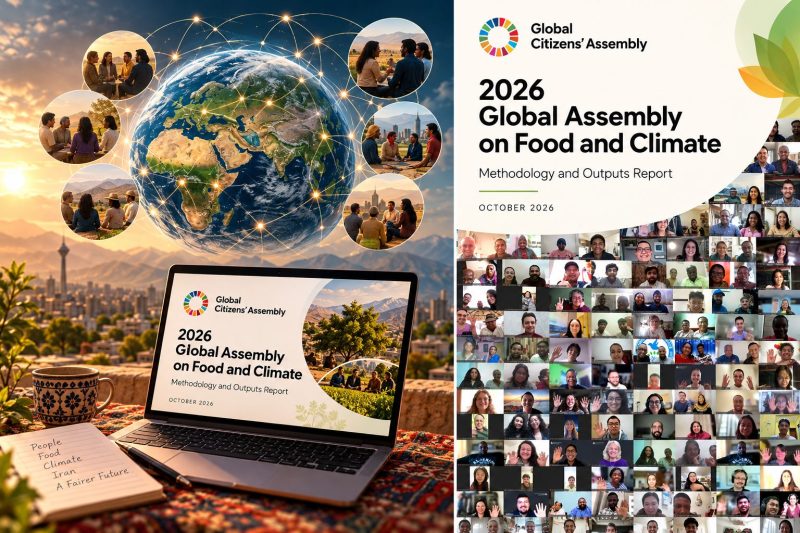
2026 Global Assembly on Food and Climate — Methodology and Outputs Report
Published by the Global Citizens’ Assembly | October 2026
Explore the complete 144-page report covering the Assembly’s methodology, global participation, key findings, and 22 Calls to Action on food systems and climate change.
The report also officially acknowledges Reza Ghiabi as Community Host for Iran (page 132).
Source: Global Citizens’ Assembly (GCA), 2026.
About the report
Methodology and Outputs Report of the 2026 Global Assembly on Food and Climate, published by the Global Citizens’ Assembly, October 2026.
The report documents the Assembly’s governance structure, participant selection methodology, deliberative process, recommendations, and lessons learned.
Iranian participation is documented on page 8 (Assembly Member) and page 132 (Community Host).
Official organization: https://globalassemblies.org